Loop, Out and Back, or One Way: Choosing a Walk
Choose a walking route shape that fits your time, scenery and appetite for retracing steps, with practical ways to compare loops, out-and-backs and one-way walks.
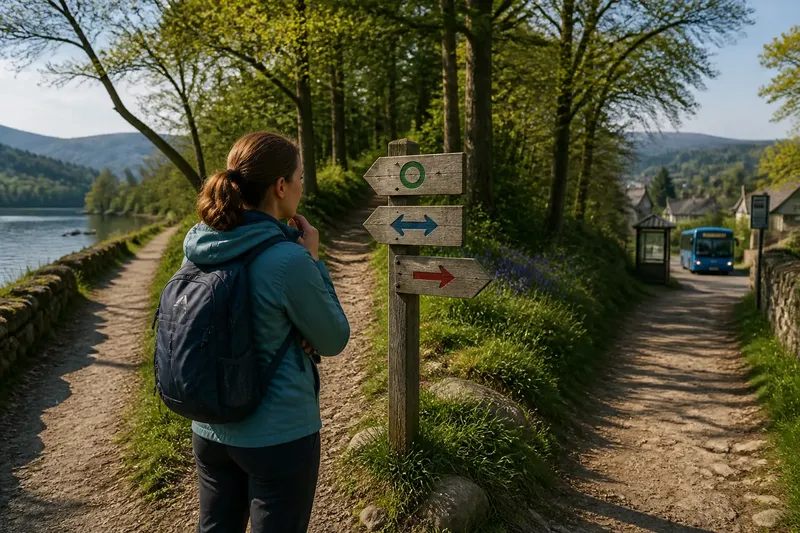
The common mistake when choosing a walk is to pick a destination first and sort out the return later. That can turn a pleasant outing into an awkward search for a ride, or make the second half feel like a replay. Choosing a walking route shape—loop, out and back, or one way—lets you match the outing to your time, scenery and appetite for seeing the same ground twice.
What changes when a walk changes shape?
A route’s shape determines where you finish, what you see on the way back, and how much coordination the outing needs. The same riverside path can feel entirely different as a short out-and-back, a loop through nearby streets, or one leg of a trip between two places.
Start with three questions: Do you need to finish where you started? Is the scenery likely to hold your interest in both directions? And can you set a firm limit on the time or distance without relying on a precise pace? Those answers point toward a shape before you open a map.
Route shape is not a ranking. A loop is not automatically more interesting, and a one-way walk is not automatically more adventurous. The useful choice is the one whose ending and return plan fit the day you actually have.
When does an out-and-back make sense?
An out-and-back follows the same route in both directions. You choose a turnaround point, then return along your approach. This makes it easy to shorten the outing: if the path, weather or available time is less appealing than expected, turn around where you are.
The shape suits routes with a clear destination or a strong feature worth approaching gradually: a bridge, a stretch of shore, a viewpoint or a quiet section of trail. It can also make sense where paths are limited and a circuit would require busy roads or an uncertain connection.
Its trade-off is repetition. Some views change as the light shifts or as you look back toward a landmark, but a narrow path beside the same hedge may offer little novelty on the return. Consider whether the route has enough variation to make the second pass feel like a different angle rather than an encore nobody requested.
An out-and-back also gives you a straightforward way to manage an uncertain schedule. Pick a turnaround cue that is easy to recognize, such as a footbridge or trail junction, rather than relying on a precise time. Keep the return in view when deciding how far to go; the route does not end at the most attractive point.
Why choose a loop?
A loop returns to its starting area by another path, so you can see new ground without arranging separate transport. It is a natural fit for a park with connected trails, a greenway joined to neighborhood sidewalks, or a walk that links several local features.
Loops are especially appealing when variety matters more than reaching one particular destination. The changing scenery helps the outing feel like a continuous circuit, and the finish is usually easy to plan because you end near the place where you began.
The map can make a loop look tidier than it feels on the ground. A short stretch along a noisy road, a confusing junction or a path that is closed can matter more than the neat outline. Check how the segments connect, and notice whether the final approach is as pleasant and accessible as the first.
Do not force a loop just to avoid retracing your steps. If closing the circuit adds an unpleasant road crossing or a confusing detour, a simple return may be the better walk. A route map is a planning aid, not a decorative challenge.
When is a one-way walk worth arranging?
A one-way walk starts and finishes in different places. It works well when the route itself is the point: a path between two neighborhoods, a trail that descends toward a village, or a promenade that ends near a café or transit stop.
The main planning question is how you will get back. You might arrange a pickup, use public transit, or connect the walk to another errand. Check the return option before setting out, including where the stop or meeting point is and whether the service suits the time you expect to finish.
One-way routes can offer a satisfying sense of progress, but they leave less room for a spontaneous change of plan. If the destination is inaccessible or the connection home falls through, you may need to retrace part of the route after all. Keep a return alternative that does not depend on everything going exactly as intended.
Say you have an afternoon free and want to follow a creek path toward a transit stop. If the service home is convenient and the route has clear access points, you can walk in one direction and finish near the stop. If the return service is sparse, choose an out-and-back to a bridge instead, so the outing does not depend on a connection you cannot easily replace.
How do you choose a walking route shape?
Use the walk’s practical constraints first, then decide how much repetition or novelty you want. A map app can show trail connections and transit stops, while a local park map may clarify entrances, gates and named junctions. Check the route itself rather than assuming a colored line means every segment is open or suitable for walking.
- Choose an out-and-back if you want a clear turnaround, an easy way to shorten the outing, or a destination along the same route.
- Choose a loop if connected paths make a comfortable circuit and you want different scenery without arranging transport.
- Choose one way if the route has a useful destination and you have a workable plan for getting home.
- Compare the least appealing segment on a loop or one-way route, not only the scenic portion shown in a photo.
- Set a turnaround or finish cue before leaving, such as a junction, bridge or transit stop, so a change in available time is easier to handle.
- Check access and connections on local maps or signs, especially where a route crosses roads, private land or seasonal gates.
Imagine a walker choosing among a lakeside path, a woodland circuit and a trail ending at a bus stop. With limited time and no interest in transport planning, the lakeside out-and-back offers a simple turnaround. If a full outing is available and the woodland paths connect cleanly, the circuit adds variety; the bus-stop finish suits a day when the walker has already checked the return service.
What do walkers often ask about route shapes?
Is a loop better than an out-and-back?
Neither is better in general. A loop avoids retracing steps when its connections are pleasant, while an out-and-back is simpler to adjust and can make a destination the focus.
How do I know where to turn around?
Choose a recognizable point before setting out, such as a bridge, trail junction or waterfront access. Leave enough time and energy for the return rather than treating the chosen point as the end of the walk.
What should I check before planning a one-way walk?
Confirm how you will return, where the pickup or transit stop is, and whether the route has a practical alternative if that plan changes. A destination is useful only if the journey home is accounted for.
Can I combine route shapes?
Yes. A short loop can lead into an out-and-back section, or a one-way path can include a small circuit near its destination. Keep the transitions clear on your map so the combined route does not become an accidental detour.
What is not worth planning?
There is little value in polishing a route outline until it looks symmetrical or finding a new path solely to avoid seeing familiar scenery twice. A familiar return can be pleasant, and a slightly irregular loop is still a loop. Spend the planning effort on access, the return arrangement and any segment you would rather avoid.
For a useful walking route shape, decide first whether you need to end where you started, then weigh variety against simplicity. A loop offers changing ground, an out-and-back offers a clear retreat, and a one-way walk offers forward progress when the return is settled. That small decision can make a nearby path fit the day instead of dictating it.