Why a Doorstep Can Change the Shape of a Day
A doorstep can make brief outdoor breaks easier to begin by keeping the route visible, the threshold usable, and a simple place to pause close at hand.
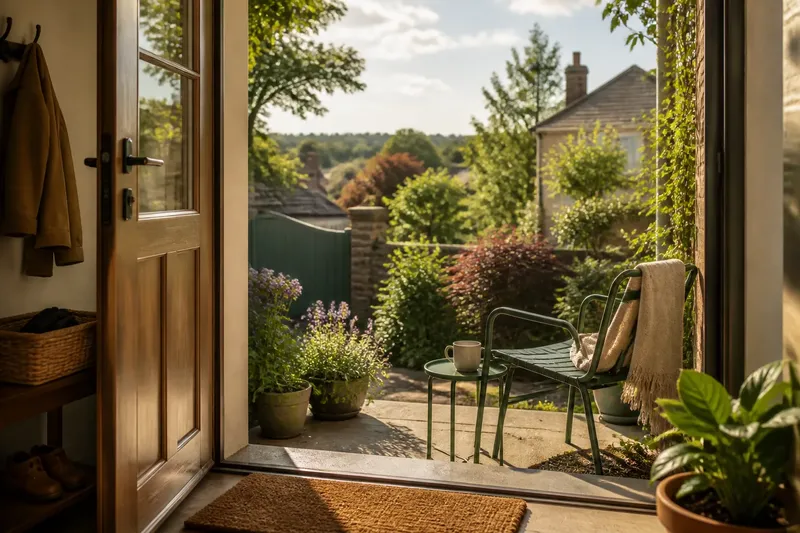
The common mistake with a doorstep is treating it as a storage strip or a passage to somewhere else. That can make a short spell outdoors feel like a separate outing, requiring a plan, a clear schedule, and the right assortment of objects. A visible, usable transition can lower that friction: the garden, stoop, balcony, or shared entry becomes an easy place to step into between ordinary tasks.
The point is not to spend longer outside or turn the threshold into a project. It is to make the first few moments outdoors feel available. If the door opens onto blocked floor space, a muddy mat, or nowhere to pause, the space quietly asks for more effort than a brief break can justify.
Why does the doorway feel like a stopping point?
A doorway can divide indoor routines from outdoor ones more sharply than the physical distance suggests. A person headed to a park expects to set aside time; a person stepping onto a porch may only want to notice the weather or take a few breaths. But if the porch is used for boxes, shoes, recycling, or tools, the threshold becomes a small job before it becomes a place.
Start by noticing what happens during a normal day. Does the door swing freely? Can you step through without shifting anything? Is there a spot where you can stand or sit without being in the way? Those observations are more useful than deciding at once that the space needs new furniture.
Clear the route first, keeping only what belongs there and is used there. A doormat that lies flat, a hook for a jacket, or a small tray for keys may help the transition; a pile of objects waiting for an indefinite future errand does not. The aim is a clean, direct path, not a threshold staged for a photograph.
What makes a short visit feel like too much trouble?
Often, the problem is a series of tiny decisions. A coat is in another room, the chair is covered, the door catches on a pot, or the only place to put a drink is indoors. None is serious alone. Together they make a casual pause feel like preparation.
Keep the useful items close to the action, but do not furnish the doorstep as if it were a second living room. A chair that can stay outdoors in the conditions it faces, a small side table, or a clean, dry place to lean may be enough. If the space is narrow, a folding chair stored just inside the door can be more practical than permanent seating that narrows the route.
Give outdoor objects a clear home. A weather-resistant basket can hold a light throw or a pair of gloves if those items are used there; a wall hook can keep a jacket from landing on a chair. Avoid storing anything that needs special care in a spot exposed to rain, direct sun, or damp air. Product labels, manufacturer directions, and local rules govern materials and fixtures where they apply.
Say you have a small back step where a watering can and a delivery box tend to collect. Moving the can beside the garden tap and bringing the box inside when it is empty could leave one clear chair-width of space; the observable change is simply that the door opens onto somewhere a person can pause without rearranging things. No renovation is involved, which is generally the less dramatic option.
How can the transition stay visible without feeling exposed?
A threshold works as an invitation when the outside is easy to see from the room and the door is easy to use. A blind corner, a screen, or a dark entry can make a small outdoor area feel farther away than it is. Where practical, keep the view through glass or an open doorway clear of tall storage and objects that block the first few feet.
Visibility does not require removing privacy. A movable screen, a trellis with open gaps, or a chair turned toward a sheltered wall can offer a sense of cover while preserving a view of the sky or a patch of greenery. The right balance depends on neighbors, the orientation of the space, and how much of the area is shared.
Lighting can also affect whether the threshold feels usable at the edges of the day. If existing outdoor lighting is adequate, avoid adding more just for atmosphere; bright fixtures can spill into nearby windows and make a small place less restful. For electrical changes, use a qualified professional rather than improvising around outdoor wiring.
What if weather and mess keep sending you back inside?
Sometimes the obstacle is not a lack of desire but a damp seat, grit underfoot, or a direct blast of wind. These are practical problems, and the answer need not be an elaborate shelter. A doormat suited to the entry, a place for wet footwear, and a seat that can be wiped dry may remove enough friction for a brief visit.
Match the setup to the conditions the space actually gets. A covered porch may keep a cushion dry; an exposed balcony may call for a chair without fabric that holds water. A small hand brush near the door can manage loose dirt, while a washable mat can catch some of what shoes bring in. Choose materials for their real exposure, not merely for how they look on a mild day.
For wind, look first at where a chair sits. A position near a wall or railing may feel calmer than the center of the space, without adding a screen that blocks light or airflow. If the weather is unpleasant enough that the space is rarely comfortable, accept that limitation and use the doorway as a view rather than trying to make every day an outdoor day.
How can an outdoor pause fit between ordinary tasks?
It helps to connect the threshold to an activity already happening. Step outside while waiting for tea to cool, after putting away groceries, or between one household task and the next. A brief pause does not need a timer, a special routine, or a new purpose beyond being outside for a moment.
Make the transition easy to repeat. Leave footwear that is suitable for the surface by the door, keep the latch unobstructed, and make sure the nearest seat is not routinely used as storage. If the space is shared, agree on a place for common items so the entry does not become a dispute disguised as a plant stand.
There is no need to fill silence with a task. A person can sit, look at the light moving across a wall, listen to the neighborhood, or simply stand while a door is open. The modest scale is the point: an outdoor break can fit into the day without competing with the day.
Which doorstep problems are worth fixing first?
Use the order below as a quick troubleshooting pass. Each item starts with a visible obstacle and the next decision, rather than a general instruction to make the space more inviting.
- The door or route is blocked: Remove objects that impede the swing or the path, then decide whether each item belongs elsewhere or needs a defined storage place.
- There is nowhere to pause: Try one movable chair or a stable place to lean, then check that it leaves the route clear.
- The seat is often wet or dirty: Choose a surface that can tolerate the conditions, and add a brush or washable mat only if debris is the recurring problem.
- Useful items keep disappearing indoors: Keep only the items that support a regular outdoor pause near the threshold, then give them a specific hook, shelf, or container.
- The space feels exposed: Change the chair’s position first; consider a screen only if a different orientation does not offer enough privacy.
- The view is hidden: Move tall storage away from the sightline, then decide whether the view improves without sacrificing needed privacy.
What questions help diagnose a doorstep that goes unused?
Does a doorstep need seating?
No. A step, a railing to lean on, or a clear patch of standing room may suit the space better than a chair. Choose seating only if sitting is something you expect to do and there is room for it without obstructing access.
Should outdoor items be kept beside the door?
Only the items that make a short visit easier belong there. A jacket or a brush may be useful; tools, empty packaging, and objects waiting for a future decision tend to turn the threshold back into storage.
What if the doorway opens onto a shared entry?
Keep the common route clear and avoid placing furniture or belongings where neighbors need to pass. A personal pause may be better suited to a private step, a courtyard corner, or another space allowed by the building’s rules.
Is a small doorstep still useful?
Yes, if it offers a safe, clear transition and a little room to stand. A view through an open door can also make outside feel nearer, even when there is no space for a chair.
What is not worth the effort?
Do not buy a coordinated set of outdoor accessories before seeing what actually keeps you from stepping outside. A decorative sign, several cushions, or a collection of small planters may add upkeep without making the route easier. Begin with the obstruction or missing convenience you can name.
Likewise, do not aim to make the space comfortable in every season. Some days are too wet, hot, cold, or windy for a pleasant pause. The useful test is whether the doorstep can serve on ordinary, tolerable days without a sequence of preparations.
A doorstep can change the shape of a day by making outside visible and close at hand, not by asking for a new routine. Keep the passage clear, place one genuinely useful thing nearby, and let the space remain small. If stepping out becomes easier, the threshold is doing its work.